"The
reality of Washington, D.C., today is that we have one party, the Republican
Party, completely dominated by big money and right wing folks. And you have
another party, the Democratic Party, too much controlled by corporate money...”
–Sen. Bernie Sanders. This is presumably why he himself is not a registered
Democrat. This is definitely why I am not one.
A lot of mainstream Democrats and Republicans do not understand why phrases like 'spoiler' and 'wasted vote' are so resented by smaller party and independent voters. The reason is simple: it profoundly offends our notions of fair play and of what democracy is supposed to be about.
I think voting is supposed to be an expression of your values and priorities. If you vote this way, you, by definition, cannot spoil democracy because this IS democracy. If you honestly believe that a Democrat or Republican better corresponds with your values and priorities than a smaller party opponent, then by all means vote for him or her.
Somebody saying, "[Democrat/Republican] is the best choice because of positions on x, y and z and is superior to [smaller party candidate] because of a, b and c" is not only fair game but exactly how democracy is supposed to work.
Whereas, somebody saying, "Vote for [smaller party candidate] is a wasted vote" or "... is only running to feed his ego" is offensive. It's saying that ideas are irrelevant to how one should vote.
(Incidentally, you don't subject yourself to the grind and expense of an electoral campaign as a smaller party candidate with no money because of the glory. It's a fairly absurd implication)
In the last Congressional race in my area, nearly 20,000 citizens voted for the Green Party candidate Matt Funiciello. Everyone did so because they thought he reflected their values and beliefs better than his Democratic and Republican opponents. If you want to those citizens and told them to their face that they only cast their votes that way to 'spoil' the race, I suspect you'd get some unpleasant reactions.
Smaller party members are going against so-called conventional wisdom simply by joining a smaller party. Most do so because they still think elections should be governed by ideas, not polls, analysis, speculation and punditry. Telling them otherwise is usually going to be counterproductive. Make the case based on ideas or don't bother.
Showing posts with label smaller parties. Show all posts
Showing posts with label smaller parties. Show all posts
Friday, May 13, 2016


Saturday, May 02, 2015
The 'two-party system' is a Stockholm Syndrome
The so-called two party system is so corrupt that even the
body charged with regulating the minimal campaign finance rules has given up hope of forcing the two parties and their candidates of respecting the law.
It still mystifies me why this system, which is a myth perpetuated by the corporate media and academics, has such a hold on the voters it works so hard to stick it to.
It still mystifies me why this system, which is a myth perpetuated by the corporate media and academics, has such a hold on the voters it works so hard to stick it to.
Friday, August 30, 2013
If the major parties don't represent us, does that mean we're stupid?
“The definition of insanity is doing the same thing over and over again and expecting different results.” –Albert Einstein
The Independent Voters Network had this op-ed piece which opined that the two major parties 'clearly and strikingly' do not represent most voters. It offers scant little evidence for this thesis, other than there are an increasing number of independent voters.
The sort of lazy excuse for analysis in this article bothers me. Giving the voters a free pass for their choices may be nice populism but does not serve the national interest.
100% of Americans are represented by either Democratic or Republican Congressmen (obviously except for two vacant seats).
99.3% of Americans are represented exclusively by major party US senators.
100% of Americans are represented by Democrat or Republican state governors.
All of them are the result of (sort of) free and fair elections.
If Americans don’t feel these two parties represent them, why do they elect exclusively them virtually all the time from among the 3-6 choices available in the majority of elections?
One can reasonably infer from this situation one of two possibilities: either a) Democratic and GOP elected officials *do* generally represent the views of most Americans or b) that voters are so stupid or gutless as to overwhelmingly elect people who don't represent them even though, in the majority of cases, there are non-major party alternatives.
Which is it?
You can bitch and moan about your cable company or your cell phone provider but as long as you keep buying their product, they don’t care. They will have no incentive to improve.
You can bitch and moan about your cable company or your cell phone provider but as long as you keep buying their product, they don’t care. They will have no incentive to improve.
Politics is the same way. The corporate parties don’t give a toss about your whining, so long as you keep buying what they sell.
If you keep voting for them, they’ll never have an incentive to change in any meaningful way. Sometimes people whine when politicians break promises but more often, the moaning comes about when a polician acts exactly as he or she suggested in the campaign!
As PJ O’Rourke concluded in his excellent book Parliament of Whores: [I]n a democracy such as ours, the whores are us.
Thursday, November 08, 2012
I was wrong: people really are content with our political system
Looks like it's time for a mea culpa.
It seems Americans are overwhelmingly content with how our political system is functioning.
I believe there were only four candidates who were on the ballot in enough states to form an electoral college majority. Democrat Obama, Republican Romney, Green Jill Stein and Libertarian Gary Johnson.
If you wanted a candidate who represented real human beings (presuming you didn't consider corporations to be such), if you wanted someone who opposed militarism and if you wanted someone who opposed corporate control of government, there were only two choices: Stein and Johnson. They were very different candidates but they were the only candidates who were pushing those fundamental conditions needed to make America into a true republican democracy.
I thought the time was right for a decent smaller party showing. People were very lukewarm about Obama and Romney. The last few years saw some very significant grassroots movements in the Tea Party (which we forget really was grassroots originally before it was hijacked by the far right money machine), by Occupy movement and the Ron Paul insurgency inside the Republican Party. This was anti-establishment discontent we hadn't seen since the days of the Vietnam aggression. Johnson and Stein were two very active, substantive candidates. They were aggressive in their use of social media (whose influence on politics is vastly overstated but in the face of a media blacklist, it was the best they could do). Each represented a significant demographic: true small government advocates dissatisfied with Republican hypocrisy on the issue and progressives disillusioned with Obama's complete abandonment of their agenda. I knew the media blacklist would be a significant barrier but I still Johnson and Stein had a reasonable shot to get 5 or 6 percent of the vote between them.
They actually combined to get 1.3 percent of the vote; all smaller candidates only combined for 2 percent. Now, 1.3 and 2 percents were orders of magnitude greater than the amount of media coverage they received, but it was still only 2 percent who voted for real change of some sort or other to our political system.
Thus 98 percent of voters voted to fundamentally preserve the status quo.
Americans complain about divided government but elected another divided government.
Congress has an approval rating of 21 percent but 90-something percent of incumbents were re-elected, as is usually the case.
People complain about both Democrats and Republicans but over 99 percent of members of Congress will be of those two parties.
Everything bad piece of public policy Americans complain about was enacted by Republicans, Democrats or, more often, both. Every 'onerous tax,' every 'job killing regulation,' every billion wasted on corporate welfare, every war of aggression that you complain about was enacted by one or both of the parties supported by 98 percent of the voters.
From this, I can draw one of two conclusions. Either Americans are actually fairly satisfied with the functioning of our political system or they are unhappy but aren't really interested in doing anything about it. Either way, the incessant whining is not compatible with either of these two options. If you're happy, why are you whining? If you're unhappy, then go beyond whining and try to do something about it.
I was wrong. I believed people when they said they wanted certain things or held certain values. But I guess was wrong to assume they'd vote for those things or values. And of course, some truly did. But from what I can tell, most didn't. Most voted against a candidate, not for one. That's their prerogative. And I'd be wrong to say I don't understand the reasoning. But I simply fail to see how change will every happen if only 2 percent of the people are willing to make it happen.
Or maybe they really don't want it to happen. Maybe they are not interested in any sort of real change on the federal level. So be it. I accept that's democracy. Just quit whining when you get what you choose.
Now people need to take the next step and quit whining about what they don't want or are not willing to change.
Friday, August 31, 2012
The purpose of voting
"It is better to vote for what you want and not get it than to vote for what you don't want and get it." - Eugene V. Debs
Saturday, August 18, 2012
Vote for humans
Eight of the top nine “contributors” to Mitt Romney’s campaign are financial institutions - including some who contributed to the economic meltdown like Wells Fargo and Bank of America.
Most of the big “contributors” to President Obama’s campaign are big tech and telecommunications conglomerates and law firms - like net neutrality opponents Time Warner and Comcast.
The poll questions that are now a substitute for political journalism shouldn’t ask which candidate you’re going to vote for. They should ask which set of corporate interests you are going to waste your vote on.
Unless your answer is that you aren’t going to waste your vote and will instead cast your ballot for a smaller party candidate who represents actual human beings... such as Green Party nominee Dr. Jill Stein or the Libertarian Gary Johnson.
Most of the big “contributors” to President Obama’s campaign are big tech and telecommunications conglomerates and law firms - like net neutrality opponents Time Warner and Comcast.
The poll questions that are now a substitute for political journalism shouldn’t ask which candidate you’re going to vote for. They should ask which set of corporate interests you are going to waste your vote on.
Unless your answer is that you aren’t going to waste your vote and will instead cast your ballot for a smaller party candidate who represents actual human beings... such as Green Party nominee Dr. Jill Stein or the Libertarian Gary Johnson.
Saturday, May 26, 2012
Why America needs multipartyism
The Liberal Ironist had an essay on the origins of partisanship in Washington. Like most analyses, it seems to be based on the erroneous premise that there was little or no partisanship in Washington prior to the 1990s. Anyone actually familiar with American history knows there have been several times when the country and the Congress have been far more bitterly divided than it is now: the late 18th/early 19th century, the Civil War and Reconstruction, the Vietnam years.
The current hyperpartisanship is really the result of the
convergence of the two major political parties on economic issues. Since Reagan's reign, BOTH major parties have veered sharply to the right on economic issues. And while liberals comfort themselves by blaming Republicans, even
Democratic presidents have pushed the conservative economic orthodoxy of
deficit reduction, tax cuts, heavy cuts to social services and the fraud mislabeled “free trade.”
Because the two parties have so heavily converged on
economic issues, the only real difference remaining between them is on social issues.
Since this is really only a small handful of issues – primarily whether gays, women
and Hispanics deserve to be treated as human beings or deserve to be treated by 14th century standards – the two parties play
these up to the hilt.
It's called the psychosis of small differences. They already agree on so much, they can't compromise on the few things they disagree with or else they will be completely identical. The illusion of choice in our corporatacracy depends upon these few differences being hyped up as much as possible so as to rally the bases.
You now have a Democratic president who’s campaigning on his
health insurance scheme... a scheme originally conceived and implemented by his Republican
opponent... who’s now attacking what he created.
I can’t think of anything that
demonstrates the convergence (as well as the cowardice, corruption and
intellectual bankruptcy) of the two corporate parties more perfectly. The Democrats have become Republicans. And the Republicans have become Medievalists. What's a rational voter to do? Follow Albert Einstein's advice and avoid the insanity of "doing the same thing over and over but expecting different results."
Vote for smaller party and independent
candidates, like Dr. Jill Stein. At the bare minimum, inform yourself about candidates from outside the two corporate parties. This will take some work, since the corporate media tends to blacklist them, but it's worth the effort.
The US is probably the only democracy in the world with so few
(two) parties represented in their national legislature – even in democratic
paragons like Russia and Zimbabwe have at least three. This won’t solve all the problems. But clearly, fresh ideas and approaches are needed and the Republicans and Democrats are not interested.
Sunday, October 31, 2010
The Nobel Committee will not be getting back to him
One of the most striking characteristics of Post-Star managing editor Ken Tingley is his pomposity. One of the ways it most often manifests itself is his penchant for breaking his arm patting himself on the back. Take this most recent example.
His column opens:
We try to eliminate excuses with our election coverage.
That's how I see our mission here at The Post-Star. We want to eliminate every possible excuse that a citizen might have for not voting. From not knowing where the polling place is, to not knowing who is on the ballot, to not knowing what a candidate stands for.
Over the past few days, we hope we have provided all that information to our readers.
I can sense a Nobel Peace Prize nomination this year... no doubt Tingley will nominate himself. I just hope when they give him the winner's ribbon, the pin doesn't puncture his ego.
That they try to remedy a citizen's 'not knowing who is on the ballot' a farcical claim, since the paper's reporting virtually ignores the majority of candidates who will be on my ballot.
Tingley self-love fest adds: I often tell people that they cannot be a good citizen if they do not subscribe to the newspaper.
And I often tell people that they cannot be a good citizen if the newspaper is their ONLY news sources. Listen to NPR. Read BBCNews.com. Watch al-Jazeera English. Read regional blogs to get perspectives the corporate daily has no idea exists (or willfully ignores). Broaden your horizons beyond the extremely narrow focus of the local newspaper and the narrower focus of the wire services most of them rely upon.
Someone who relied on the Glens Falls daily as their sole news source would have little idea of all the candidates on the ballot for governor, would have no idea of all the candidates on the ballot for comptroller, attorney general and both US Senate races and even less idea what these candidates stand for. The rent may be too damn high but some candidates have an agenda broader than that.
People who relied solely on The Post-Star would know nothing about the serious candidates but would be greatly informed about Andrew Cuomo's love life and Carl Paladino's penchant for horse porn. Thanks Ken!
Oh wait, amidst the hundreds of articles on the corporate party candidates, the paper did do a real article (singular) on one of the smaller party candidates for governor: Howie Hawkins and his visit to Glens Falls.
Tingley's right. This IS their most in-depth election coverage ever!
Except it's a sad indictment of what Tingley and most of the media view as worthy of flowery self-congratulation.
Note: If you really want to learn about all the options, forget The Post-Star which is obviously uninterested in doing such legwork (gotta have room for horse porn and poll analyses!). Instead, check out this voter guide by the non-partisan and well-respected New York state League of Women Voters. It has information about ALL the candidates running for statewide office.
Update: I was listening to a wrap up on WAMC about the attorney general debate where the questioners were discussing the event. New York public radio’s Karen Dewitt said she was going to ask a question about hydrofracking but didn’t because they were running out of time and they’d promised to ask a question about Carl Paladino.
Here, you have one of the most respected reporters of state politics scrapping a question about a tremendously serious issue of public policy to a large chunk of the state in favor of one about tabloid personality politics. I think most voters would’ve rather had the serious question in the debate and been allowed to go to the New York Post instead for the tabloid stuff.
His column opens:
We try to eliminate excuses with our election coverage.
That's how I see our mission here at The Post-Star. We want to eliminate every possible excuse that a citizen might have for not voting. From not knowing where the polling place is, to not knowing who is on the ballot, to not knowing what a candidate stands for.
Over the past few days, we hope we have provided all that information to our readers.
I can sense a Nobel Peace Prize nomination this year... no doubt Tingley will nominate himself. I just hope when they give him the winner's ribbon, the pin doesn't puncture his ego.
That they try to remedy a citizen's 'not knowing who is on the ballot' a farcical claim, since the paper's reporting virtually ignores the majority of candidates who will be on my ballot.
Tingley self-love fest adds: I often tell people that they cannot be a good citizen if they do not subscribe to the newspaper.
And I often tell people that they cannot be a good citizen if the newspaper is their ONLY news sources. Listen to NPR. Read BBCNews.com. Watch al-Jazeera English. Read regional blogs to get perspectives the corporate daily has no idea exists (or willfully ignores). Broaden your horizons beyond the extremely narrow focus of the local newspaper and the narrower focus of the wire services most of them rely upon.
Someone who relied on the Glens Falls daily as their sole news source would have little idea of all the candidates on the ballot for governor, would have no idea of all the candidates on the ballot for comptroller, attorney general and both US Senate races and even less idea what these candidates stand for. The rent may be too damn high but some candidates have an agenda broader than that.
People who relied solely on The Post-Star would know nothing about the serious candidates but would be greatly informed about Andrew Cuomo's love life and Carl Paladino's penchant for horse porn. Thanks Ken!
Oh wait, amidst the hundreds of articles on the corporate party candidates, the paper did do a real article (singular) on one of the smaller party candidates for governor: Howie Hawkins and his visit to Glens Falls.
Tingley's right. This IS their most in-depth election coverage ever!
Except it's a sad indictment of what Tingley and most of the media view as worthy of flowery self-congratulation.
Note: If you really want to learn about all the options, forget The Post-Star which is obviously uninterested in doing such legwork (gotta have room for horse porn and poll analyses!). Instead, check out this voter guide by the non-partisan and well-respected New York state League of Women Voters. It has information about ALL the candidates running for statewide office.
Update: I was listening to a wrap up on WAMC about the attorney general debate where the questioners were discussing the event. New York public radio’s Karen Dewitt said she was going to ask a question about hydrofracking but didn’t because they were running out of time and they’d promised to ask a question about Carl Paladino.
Here, you have one of the most respected reporters of state politics scrapping a question about a tremendously serious issue of public policy to a large chunk of the state in favor of one about tabloid personality politics. I think most voters would’ve rather had the serious question in the debate and been allowed to go to the New York Post instead for the tabloid stuff.
Saturday, October 30, 2010
You’ll never get change by voting for the same old, same old
The New York Post had a front page story which reported: A Rasmussen Reports survey released yesterday found 65 percent of likely voters would prefer to fire every member of Congress and start from scratch... 53 percent of American voters dislike Democrats, and 54 percent dislike Republicans.
And yet most polls show that nationally, at least 85 percent of voters are already committed to voting for a Democrat or Republican... and no doubt, few of the undecideds will go elsewhere.
So most Americans want to get rid of all of Congress because they view Democrats and Republicans as responsible for most of the problems in Washington. But their idea of a solution is to replace those awful Democrats and Republicans with... Republicans and Democrats.
As Benjamin Franklin said, "The definition of insanity is doing the same thing over and over and expecting different results."
It seems that Jon Stewart's Election to Restory Sanity is coming not a day too soon.
For a non-insane option, consider voting for a Green Party candidate (such as New York gubernatorial candidate Howie Hawkins) if one is available or for another smaller party or independent candidate.
And yet most polls show that nationally, at least 85 percent of voters are already committed to voting for a Democrat or Republican... and no doubt, few of the undecideds will go elsewhere.
So most Americans want to get rid of all of Congress because they view Democrats and Republicans as responsible for most of the problems in Washington. But their idea of a solution is to replace those awful Democrats and Republicans with... Republicans and Democrats.
As Benjamin Franklin said, "The definition of insanity is doing the same thing over and over and expecting different results."
It seems that Jon Stewart's Election to Restory Sanity is coming not a day too soon.
For a non-insane option, consider voting for a Green Party candidate (such as New York gubernatorial candidate Howie Hawkins) if one is available or for another smaller party or independent candidate.
Wednesday, October 20, 2010
The Death of the Liberal Class
"Democracy is one man, one vote. Corporatism is one dollar, one vote." -Chris Hedges
Unfortunately, I missed the great Chris Hedges speak in (sort of) nearby Troy at the Sanctuary for Independent Media, though I was told by friends he was fantastic. Hedges spoke about his new book The Death of the Liberal Class. It’s definitely a book I will have to pick up. The publisher’s description of the book is quite revealing itself.
The Death of the Liberal Class examines the failure of the liberal class to confront the rise of the corporate state and the consequences of a liberalism that has become profoundly bankrupted. Hedges argues there are five pillars of the liberal establishment – the press, liberal religious institutions, labor unions, universities and the Democratic Party— and that each of these institutions, more concerned with status and privilege than justice and progress, sold out the constituents they represented. In doing so, the liberal class has become irrelevant to society at large and ultimately the corporate power elite they once served.
Unfortunately, I missed the great Chris Hedges speak in (sort of) nearby Troy at the Sanctuary for Independent Media, though I was told by friends he was fantastic. Hedges spoke about his new book The Death of the Liberal Class. It’s definitely a book I will have to pick up. The publisher’s description of the book is quite revealing itself.
The Death of the Liberal Class examines the failure of the liberal class to confront the rise of the corporate state and the consequences of a liberalism that has become profoundly bankrupted. Hedges argues there are five pillars of the liberal establishment – the press, liberal religious institutions, labor unions, universities and the Democratic Party— and that each of these institutions, more concerned with status and privilege than justice and progress, sold out the constituents they represented. In doing so, the liberal class has become irrelevant to society at large and ultimately the corporate power elite they once served.
Wednesday, October 13, 2010
Media deceit, smaller party candidates and good business sense
When challenged about their blacklisting of smaller party/independent candidates, the Post-Star and other corporate outlets usually offer the rationalization that they don't have 'space' or 'resources' to waste on candidates they decree 'no one is interested in'... despite evidence to the contrary.
The lack of resources argument is a common theme. In this blog piece, Post-Star managing editor Ken Tingley began: "I’m often surprised when a reader suggests that we should get one of our investigative reporters on a story," before going on to explain how expensive journalism was. Though readers can rest assured that they will always find resources to do dubious pieces on anything related to the Adirondack Park Agency or green groups.
Still, Tingley's admission is rather startling. If I ran a newspaper, I wouldn't be surprised when readers suggested investigating a story. I'd be flattered.
One reader of this blog emailed me with these comments on the blog piece (posted with his permission): He states that the P-S has eight news reporters and five sports reporters. The staff email directory lists nine news reporters and six sports reporters (not counting stringers). Unless this is his way of announcing another round of staffing cuts, Mr. Tingley should really consider getting someone to check his arithmetic as well as his grammar and spelling.
Incidentally, Mr. Tingley's latest tweet—beside the explanation of how difficult it is to assign investigative pieces—is a comment to the effect that with baseball playoffs coming it will be tough getting to work for the next few weeks. Priorities, Ken.
The Post-Star, like most corporate media outlets, has chosen not to cover any of the five smaller party candidates on the ballot for governor of New York.
(To its credit, the Long Island paper Newsday is co-sponsoring a debate on October 18 involving ALL the gubenatorial candidates.)
Despite its blacklist against candidates it decrees 'not serious,' The Post-Star managed to find precious resources and space to run a story on some guy running a write-in campaign, one who admits to consciously "not taking many positions, hardly any at all."
However, the 'lesser known candidates' on the ballot mentioned in a side graphic to the article (but nowhere else) are on the ballot precisely because they gained thousands of signatures to put them there.
The paper claims not to have space or resources to cover these serious candidates (who take actual positions!) who've done the hard work of generating interest but they find resources and *front page* space to cover this Green Tea guy (to say nothing of all the empty personality politics and polls analysis articles about the major party candidates).
In response to past criticisms of the same nature, Tingley has emailed me to complain, angrily asking me to tell him when his paper has been unfair. In his mind, they give about equal coverage to both the Democratic candidate and the Republican candidate, hence it's fair.
Or to put in a way the former sports editor might understand. In his eyes, an umpire can be biased against the other 28 Major League Baseball teams but as long as he treats the Red Sox the same as the Yankees, then he's 'fair.'
In the corporate media's eyes, fairness means ignoring the overwhelming majority of the candidates or given them only the occasional token mention while running hundreds of empty articles on polls or the personal lives of the major party candidates. Fairness means ignoring smaller party candidates in a nation where the majority of people want more than two parties. All we need now is the self-appointed advocates for the public to report on those that already exist. Who knows? Maybe if newspapers gave their audience what it wanted, it might prevent that audience from shrinking even more.
The lack of resources argument is a common theme. In this blog piece, Post-Star managing editor Ken Tingley began: "I’m often surprised when a reader suggests that we should get one of our investigative reporters on a story," before going on to explain how expensive journalism was. Though readers can rest assured that they will always find resources to do dubious pieces on anything related to the Adirondack Park Agency or green groups.
Still, Tingley's admission is rather startling. If I ran a newspaper, I wouldn't be surprised when readers suggested investigating a story. I'd be flattered.
One reader of this blog emailed me with these comments on the blog piece (posted with his permission): He states that the P-S has eight news reporters and five sports reporters. The staff email directory lists nine news reporters and six sports reporters (not counting stringers). Unless this is his way of announcing another round of staffing cuts, Mr. Tingley should really consider getting someone to check his arithmetic as well as his grammar and spelling.
Incidentally, Mr. Tingley's latest tweet—beside the explanation of how difficult it is to assign investigative pieces—is a comment to the effect that with baseball playoffs coming it will be tough getting to work for the next few weeks. Priorities, Ken.
The Post-Star, like most corporate media outlets, has chosen not to cover any of the five smaller party candidates on the ballot for governor of New York.
(To its credit, the Long Island paper Newsday is co-sponsoring a debate on October 18 involving ALL the gubenatorial candidates.)
Despite its blacklist against candidates it decrees 'not serious,' The Post-Star managed to find precious resources and space to run a story on some guy running a write-in campaign, one who admits to consciously "not taking many positions, hardly any at all."
However, the 'lesser known candidates' on the ballot mentioned in a side graphic to the article (but nowhere else) are on the ballot precisely because they gained thousands of signatures to put them there.
The paper claims not to have space or resources to cover these serious candidates (who take actual positions!) who've done the hard work of generating interest but they find resources and *front page* space to cover this Green Tea guy (to say nothing of all the empty personality politics and polls analysis articles about the major party candidates).
In response to past criticisms of the same nature, Tingley has emailed me to complain, angrily asking me to tell him when his paper has been unfair. In his mind, they give about equal coverage to both the Democratic candidate and the Republican candidate, hence it's fair.
Or to put in a way the former sports editor might understand. In his eyes, an umpire can be biased against the other 28 Major League Baseball teams but as long as he treats the Red Sox the same as the Yankees, then he's 'fair.'
In the corporate media's eyes, fairness means ignoring the overwhelming majority of the candidates or given them only the occasional token mention while running hundreds of empty articles on polls or the personal lives of the major party candidates. Fairness means ignoring smaller party candidates in a nation where the majority of people want more than two parties. All we need now is the self-appointed advocates for the public to report on those that already exist. Who knows? Maybe if newspapers gave their audience what it wanted, it might prevent that audience from shrinking even more.
Friday, September 24, 2010
Calling all smaller party and independent candidates!
If you rely solely for your news solely on the mainstream media, the types that pontificate on the importance of media literacy, chances are you won't be too well informed. You'd probably think that the only candidates for governor of this state were the Democrat and the Republican (and maybe the other Republican). You'd probably have no idea that there are EIGHT other candidates for governor besides those from the two major parties.
The corporate media only covers the corporate parties, no surprise there. The media's infatuation with polls has its limits: it ignores the one that shows that 58 percent of Americans think a third party is needed.
Of course, there ARE 'third parties' in this country, but most people aren't aware of them because... oh wait, I already covered this.
So one thing I will do is open this blog up to publishing statements from any candidate for office in NYS from outside the Republicrats.
Obviously, this isn't a substitute for the actual journalism that professional reporters should be doing but since the corporate party candidates get tons of free air time and print in the corporate media and other candidates get virtually none, it's the best I can do.
This offer is not open to any registered Democrat or Republican who is running on a third party line, a process which I believe subvets attempts at real multipartyism. The offer is only open to candidates actually registered in a smaller party or registered independents.
If interested, please email me at: mofycbsj @ yahoo.com
The corporate media only covers the corporate parties, no surprise there. The media's infatuation with polls has its limits: it ignores the one that shows that 58 percent of Americans think a third party is needed.
Of course, there ARE 'third parties' in this country, but most people aren't aware of them because... oh wait, I already covered this.
So one thing I will do is open this blog up to publishing statements from any candidate for office in NYS from outside the Republicrats.
Obviously, this isn't a substitute for the actual journalism that professional reporters should be doing but since the corporate party candidates get tons of free air time and print in the corporate media and other candidates get virtually none, it's the best I can do.
This offer is not open to any registered Democrat or Republican who is running on a third party line, a process which I believe subvets attempts at real multipartyism. The offer is only open to candidates actually registered in a smaller party or registered independents.
If interested, please email me at: mofycbsj @ yahoo.com
Thursday, September 23, 2010
Are journalists slaves to polling companies?
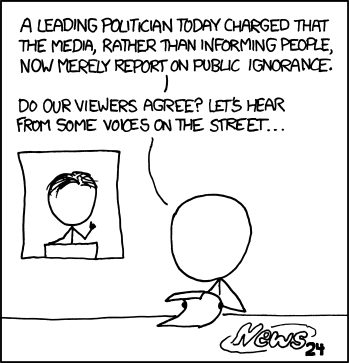
"At times it feels as if American politics consists largely of candidates without ideas hiring consultants without convictions to stage campaigns without content. Increasingly the result is elections without voters." –Gerald Ford
I’m a big fan of North Country Public Radio’s Brian Mann. I think he’s probably the best journalist in this area. His news stories are fair (different than neutral) as well as offering a depth and nuance pretty much unseen in this region’s journalism. But one of his weaknesses is his infatuation with the horse race of politics; this blog piece where he went on about a poll regarding the NY governor’s race is a recent example. I won’t crucify him for it because his real journalism is of such quality. But as someone who’s regularly criticized the overreliance on polls that cripples modern journalism, I wish he’d tone it down a bit.
I think journalists are infatuated by polls because they are far easier to frame than more complex (and more relevant) stories about issues. The way stories about polls are framed are remarkably similar to the way stories about sports are often framed. But ESPN's hype machine aside, most sports journalists don't pass their work off as being of epic importance.
Polls really are a a crutch of modern journalism. As I’ve said before, polls can be useful when they illuminate a story or issue. Far too often, though, they ARE the story. Polls fine as the dessert – fine in small quantities, easy to digest but with little nutritional value; instead, they are usually passed off as the main course – thus we get a malnourished civic soul.
I am convinced that this is a reason why ordinary people are tuning out of politics and why they are losing respect for journalism. Nearly all the coverage, and I mean in the state media in general not just Mann's blog, of the governor’s race is based on polls; this was exacerbated when a poll was released showing the GOP’s Carl Paladino only 6 points behind Democrat Andrew Cuomo. The small rest of the gubernatorial coverage has about Paladino’s controversial personality and emails he once sent.
I’ve seen hardly anything about the FOUR other statewide races, those for attorney general, comptroller and two US Senate seats. There was a little coverage about the Democratic attorney general primary (again mostly focused on the polls and who was 'ahead') but virtually none since.
The state is in a crisis but journalists seem to think that no one’s interested in hearing ideas about how to address the crisis and that everyone's more worried about the little parlor games of polls that ignore most of the candidates anyway.
Yes, the only people talking about issues and ideas are the smaller party candidates... this is almost always how it is. But if the media is going to blacklist those smaller party candidates and perpetuate the deceit that they don't exist, don’t they at least have a responsibility to press the major party candidates to talk about real issues, not just a candidate's crude emails or lineage?
Oh wait, I have to go. A poll shows that Paladino’s popularity has increased by 0.0441 percent since 22 minutes ago. Stop the presses! I need to write a story about this Earth-shattering development!
Update: Matt Funiciello offers his take.
Second update: Curiously, the media's infatuation with polls doesn't seem to extend to the one that shows 58% of Americans think the Republicans and Democrats so inadequate that a third party is needed. Of course, there ARE 'third parties' so this means that the majority of Americans think the media should actually cover them, like is done in the media of every other democracy.
Sunday, November 08, 2009
Lushes (of the non-teen variety) have an advocate on the corner of Cooper and Lawrence
Editorials speak not just about the positions of a newspaper, but about its priorities. As I've mentioned on this blog many times, New York state electoral law is badly rigged in favor of Democrats and Republicans (as well as their factions: the fake parties of the Working Families and Conservative Parties) by putting obscene hurdles to participation by smaller parties and independents.
The Post-Star has often espoused as "throw the bums out" editorial line with regard to the legislature in Albany but has never seen fit to link that to broader electoral reform that would enable much-needed real multipartyism. Yet yesterday, the daily ran what is at least their second editorial denouncing bureaucratic problems of the state Liquor Authority; there have been several investigative news articles on the topic as well.
Based on their editorial judgement, having increased options to buy a bottle of Wild Turkey or Absolut seems a far more important priority to the paper than multiparty democracy.
This is particularly ironic considering that one of their other editorial crusades is against teen... drinking.
The Post-Star has often espoused as "throw the bums out" editorial line with regard to the legislature in Albany but has never seen fit to link that to broader electoral reform that would enable much-needed real multipartyism. Yet yesterday, the daily ran what is at least their second editorial denouncing bureaucratic problems of the state Liquor Authority; there have been several investigative news articles on the topic as well.
Based on their editorial judgement, having increased options to buy a bottle of Wild Turkey or Absolut seems a far more important priority to the paper than multiparty democracy.
This is particularly ironic considering that one of their other editorial crusades is against teen... drinking.
Friday, August 21, 2009
Don't belong to the Party of No
One of the things I've learned as a political junkie and wannabe-activist is that you can simply say No, No, No all the time. You have to offer people something to say Yes to.
In a previous essay, I took issue with some comments made by my friend PCS at Adirondack Musing blog. He promptly offered a response of his own. In it, he "asked [me] to give [him] the secret plans of how the Green Party is going to gain control of our government...."
I explained to him a little about American history; history which has repeatedly shown that organizations can have a huge influence on the direction of policy even without a majority of seats in a legislative body or none at all. In the early 20th century, the Progressive Party had a major influence in pushing progressive items, like anti-child labor laws and the health and safety labor regulations, that are now considered basic in any civilized society. They never controlled the presidency and I don't believe they ever controlled any governorship or state legislative chamber. Movements like the Southern Christian Leadership Conference, NAACP, abolitionists and women's suffrage organizations weren't political parties at all.
All of these movements and parties succeeded not by crossing their fingers and wishing for the best for years upon years upon decades. They demanded not Hope but action. They succeeded by putting pressure on elected officials, without regard to party. Pressure that included threatening to withhold votes, support and money... and the willingness to follow through.
They weren't timid and meek. And most importantly, they weren't in hoc to any one particular party or individual (a key principle which the US labor movement singularly failed to learn, with results we can all see). Their responsibility was to their beliefs. As the political axiom goes, "There are no permanent allies, only permanent interests."
Politicians and parties worry about getting elected. Citizens must be more concerned with what's done once elected.
All citizens should be responsible to their beliefs, not their political party or any particular politician. The party and the candidates need to be servants, not masters.
I did point out to PCS that the first step in the Greens not-so-secret plan is to persuade people like him who clearly have sympathy with the Green agenda to actually vote for the party or, at the very least, consider it.
But none of this seemed to persuade my friend. He clearly thinks that the idea of the Greens or any other so-called third party making a difference is not pragmatic, is unrealistic.
So be it.
But in terms of how to the citizens can take back the government from the corporations, I've never heard from him or anyone else a realistic, viable alternative to real multipartyism.
So I will throw his challenge back at him.
If multipartyism is not his answer, then what is HIS illuminating secret plan to reinvigorate and render effective the progressive movement in the United States?
Any readers are invited to share their suggestions too.
Don't belong to the Party of No.
In a previous essay, I took issue with some comments made by my friend PCS at Adirondack Musing blog. He promptly offered a response of his own. In it, he "asked [me] to give [him] the secret plans of how the Green Party is going to gain control of our government...."
I explained to him a little about American history; history which has repeatedly shown that organizations can have a huge influence on the direction of policy even without a majority of seats in a legislative body or none at all. In the early 20th century, the Progressive Party had a major influence in pushing progressive items, like anti-child labor laws and the health and safety labor regulations, that are now considered basic in any civilized society. They never controlled the presidency and I don't believe they ever controlled any governorship or state legislative chamber. Movements like the Southern Christian Leadership Conference, NAACP, abolitionists and women's suffrage organizations weren't political parties at all.
All of these movements and parties succeeded not by crossing their fingers and wishing for the best for years upon years upon decades. They demanded not Hope but action. They succeeded by putting pressure on elected officials, without regard to party. Pressure that included threatening to withhold votes, support and money... and the willingness to follow through.
They weren't timid and meek. And most importantly, they weren't in hoc to any one particular party or individual (a key principle which the US labor movement singularly failed to learn, with results we can all see). Their responsibility was to their beliefs. As the political axiom goes, "There are no permanent allies, only permanent interests."
Politicians and parties worry about getting elected. Citizens must be more concerned with what's done once elected.
All citizens should be responsible to their beliefs, not their political party or any particular politician. The party and the candidates need to be servants, not masters.
I did point out to PCS that the first step in the Greens not-so-secret plan is to persuade people like him who clearly have sympathy with the Green agenda to actually vote for the party or, at the very least, consider it.
But none of this seemed to persuade my friend. He clearly thinks that the idea of the Greens or any other so-called third party making a difference is not pragmatic, is unrealistic.
So be it.
But in terms of how to the citizens can take back the government from the corporations, I've never heard from him or anyone else a realistic, viable alternative to real multipartyism.
So I will throw his challenge back at him.
If multipartyism is not his answer, then what is HIS illuminating secret plan to reinvigorate and render effective the progressive movement in the United States?
Any readers are invited to share their suggestions too.
Don't belong to the Party of No.
Friday, March 27, 2009
Sundwall endorses Murphy
According to a statement on Eric Sundwall's website, the Libertarian has endorsed Democrat Scott Murphy for the race he was denied his civic right to participate in by allies of Republican Jim Tedisco.
I'm not sure I agree with this endorsement -- I'm more inclined at this point to write in either Sundwall or Anthony Cerro -- but I certainly understand Sundwall's decision as well as sharing his fury.
Given the general public revulsion with the Republican National Campaign Committee attack ads (not that there's any love for attack ads run by the Democratic equivalent) and now with the Conservative enemies of democracy, I wonder if Tedisco's rueing who he's gotten in bed with.
The latest poll shows that Tedisco, once ahead by 20 points, now trails Murphy by 4 points... and this was before Sundwall's endorsement. I'm sure the Tedisco campaign's (at best) silent complicity with this mugging of democracy will hurt his numbers even more.
From: Sundwall4congress.org
The decision of the Board of Election to remove my name from the ballot proves once again that the political system in New York is rigged by professionals to make sure that average citizens are excluded from the process. While the two major parties could choose their candidates in a smoke-filled room, they made us go out and attempt the impossible: obtain 3500 valid signatures in just 12 days. We came very close but ultimately, the technicalities they built into the law to disenfranchise the people proved too strong
to overcome.
In addition, I faced baseless allegations of wrongdoing and threats of criminal prosecution in a lawsuit brought by Tedisco supporters. While I wanted to file a lawsuit in Albany County to overturn the Board's decision, we got stuck down in Dutchess County where the machine felt they would have a friendly bench. While the court there should have dismissed that lawsuit as moot, the judge instead was prepared to keep us down there litigating silly issues concerning the Libertarian Party emblem and whether witnessing signatures from outside the district constitutes fraud. There was no end in sight and we might have been down there for days facing the inevitable loss with no time to appeal and no time to campaign either. The Tedisco supporters who brought the case sought and received an order requiring me to be present in Court, thereby preventing me from campaigning.
I was also concerned that continued litigation would jeopardize the ballots of military personnel and disabled voters who use special machines that need to be programmed several days before the election.
Faced with the prospect of spending much of the rest of campaign on the witness stand being harassed by the machine's hired gun, I chose not to play that game. Since I could not file suit in the county of my choosing, I decided to end my candidacy and not subject myself and my family to any further abuse, threats or harassment from the political machine.
Thus, the Stalinist New York Election Law forced us to spend the first half of the campaign getting signatures and the second half fighting a lost cause in court.
The voters will be deprived of any choice but the two parties that have destroyed the nation's economy in recent years and have us bogged down in two land wars in Asia.
Mr. Tedisco denies any involvement with the concerted effort by his supporters to knock me off the ballot. I don't believe him. The ruthless effort by his supporters to knock me off the ballot without a word of protest by him proves his unfitness for any office let alone Congress in these critical times.
I will be voting for Scott Murphy on Tuesday. While we disagree on some important issues, I find him to be a man of honor, a good family man and successful businessman. Unlike Tedisco, he actually lives in the District. And, unlike Mr. Tedisco, I view Scott's business success as a virtue, not a vice.
I urge my supporters and all those who believe in open and free elections to show their disgust at the tactics of the Republican political machine to win at all costs. Please join me in voting for Scott Murphy on Tuesday.
I want to thank all those who worked tirelessly on my behalf and who donated their precious funds to help this effort. And I wish to thank the media for all their courtesies during this Sysiphean struggle.
We live to fight another day.
Eric Sundwall
I'm not sure I agree with this endorsement -- I'm more inclined at this point to write in either Sundwall or Anthony Cerro -- but I certainly understand Sundwall's decision as well as sharing his fury.
Given the general public revulsion with the Republican National Campaign Committee attack ads (not that there's any love for attack ads run by the Democratic equivalent) and now with the Conservative enemies of democracy, I wonder if Tedisco's rueing who he's gotten in bed with.
The latest poll shows that Tedisco, once ahead by 20 points, now trails Murphy by 4 points... and this was before Sundwall's endorsement. I'm sure the Tedisco campaign's (at best) silent complicity with this mugging of democracy will hurt his numbers even more.
From: Sundwall4congress.org
The decision of the Board of Election to remove my name from the ballot proves once again that the political system in New York is rigged by professionals to make sure that average citizens are excluded from the process. While the two major parties could choose their candidates in a smoke-filled room, they made us go out and attempt the impossible: obtain 3500 valid signatures in just 12 days. We came very close but ultimately, the technicalities they built into the law to disenfranchise the people proved too strong
to overcome.
In addition, I faced baseless allegations of wrongdoing and threats of criminal prosecution in a lawsuit brought by Tedisco supporters. While I wanted to file a lawsuit in Albany County to overturn the Board's decision, we got stuck down in Dutchess County where the machine felt they would have a friendly bench. While the court there should have dismissed that lawsuit as moot, the judge instead was prepared to keep us down there litigating silly issues concerning the Libertarian Party emblem and whether witnessing signatures from outside the district constitutes fraud. There was no end in sight and we might have been down there for days facing the inevitable loss with no time to appeal and no time to campaign either. The Tedisco supporters who brought the case sought and received an order requiring me to be present in Court, thereby preventing me from campaigning.
I was also concerned that continued litigation would jeopardize the ballots of military personnel and disabled voters who use special machines that need to be programmed several days before the election.
Faced with the prospect of spending much of the rest of campaign on the witness stand being harassed by the machine's hired gun, I chose not to play that game. Since I could not file suit in the county of my choosing, I decided to end my candidacy and not subject myself and my family to any further abuse, threats or harassment from the political machine.
Thus, the Stalinist New York Election Law forced us to spend the first half of the campaign getting signatures and the second half fighting a lost cause in court.
The voters will be deprived of any choice but the two parties that have destroyed the nation's economy in recent years and have us bogged down in two land wars in Asia.
Mr. Tedisco denies any involvement with the concerted effort by his supporters to knock me off the ballot. I don't believe him. The ruthless effort by his supporters to knock me off the ballot without a word of protest by him proves his unfitness for any office let alone Congress in these critical times.
I will be voting for Scott Murphy on Tuesday. While we disagree on some important issues, I find him to be a man of honor, a good family man and successful businessman. Unlike Tedisco, he actually lives in the District. And, unlike Mr. Tedisco, I view Scott's business success as a virtue, not a vice.
I urge my supporters and all those who believe in open and free elections to show their disgust at the tactics of the Republican political machine to win at all costs. Please join me in voting for Scott Murphy on Tuesday.
I want to thank all those who worked tirelessly on my behalf and who donated their precious funds to help this effort. And I wish to thank the media for all their courtesies during this Sysiphean struggle.
We live to fight another day.
Eric Sundwall
Thursday, March 26, 2009
How to steal democracy and disenfranchise people
"Nothing in all the world is more dangerous than sincere ignorance and conscientious stupidity." -Dr. Martin Luther King Jr.
After completely ignoring him ever since he got into the race, The Post-Star's print edition has finally decided to report on Libertarian Eric Sundwall.
The first article was related to his (eventually) unsuccessful fight to stay on the ballot... two weeks after the fight started and a day before it ended. The second and last article was a front page article on him being kicked off the ballot.
They also wrote a transparent editorial calling for him to be allowed in the ballot. It's transparent because it came nearly two weeks after his petitions were challenged. In other words, they waited to editorialize about it until they knew it wouldn't make a difference.
The editorial praising the importance of a diversity of voices was published on the same day as was held a debate co-sponsored by The Post-Star. Sundwall was not invited to this debate. The daily's actions speak a lot louder than their words.
The afforementioned article from today did detail the main reason Sundwall's petitions were rejected.
What was the reason that thousands of law-abiding Americans were disenfranchised? Did Sundwall's campaign get signatures from dead people? Did it get pages of signatures from illegal immigrants from Outer Mongolia?
No.
The majority of the signatures that the board threw out were because the individual who circulated the petitions and witnessed the signatures listed the hamlet of Manorville as his residence instead of the town of Brookhaven, where Manorville is located.
For locals, that's the equivalent of someone listing their residence as West Glens Falls instead of Queensbury.
One person wasn't even wrong in filling out one line of a form. He didn't lie or deceive. Quite the opposite. His 'crime' was that he was too precise. That was the justification for denying one law-abiding American his civic right to run for public office and for disenfranchising thousands of others.
How can any person with an ounce of conscience or patriotism justify this?
This is what happens when ordinary people, without personal fortune or oodles of corporate cash, tries to participate in the 'democratic' process.
After completely ignoring him ever since he got into the race, The Post-Star's print edition has finally decided to report on Libertarian Eric Sundwall.
The first article was related to his (eventually) unsuccessful fight to stay on the ballot... two weeks after the fight started and a day before it ended. The second and last article was a front page article on him being kicked off the ballot.
They also wrote a transparent editorial calling for him to be allowed in the ballot. It's transparent because it came nearly two weeks after his petitions were challenged. In other words, they waited to editorialize about it until they knew it wouldn't make a difference.
The editorial praising the importance of a diversity of voices was published on the same day as was held a debate co-sponsored by The Post-Star. Sundwall was not invited to this debate. The daily's actions speak a lot louder than their words.
The afforementioned article from today did detail the main reason Sundwall's petitions were rejected.
What was the reason that thousands of law-abiding Americans were disenfranchised? Did Sundwall's campaign get signatures from dead people? Did it get pages of signatures from illegal immigrants from Outer Mongolia?
No.
The majority of the signatures that the board threw out were because the individual who circulated the petitions and witnessed the signatures listed the hamlet of Manorville as his residence instead of the town of Brookhaven, where Manorville is located.
For locals, that's the equivalent of someone listing their residence as West Glens Falls instead of Queensbury.
One person wasn't even wrong in filling out one line of a form. He didn't lie or deceive. Quite the opposite. His 'crime' was that he was too precise. That was the justification for denying one law-abiding American his civic right to run for public office and for disenfranchising thousands of others.
How can any person with an ounce of conscience or patriotism justify this?
This is what happens when ordinary people, without personal fortune or oodles of corporate cash, tries to participate in the 'democratic' process.
Wednesday, March 25, 2009
Sundwall out: report
Maury Thompson's blog reports that Libertarian Eric Sundwall has stopped the costly legal efforts to be allowed to participate in the 'democratic' process.
"Instead of campaigning, we have been forced to have Eric Sundwall spend time and money in court," campaign manager Richard Cooper said in a statement issued this afternoon.
The challenges were initiated by two leading members of the Conservative Party, which endorsed Tedisco. As reported earlier, the lawyer representing the Conservatives had close ties to state Senate Republicans.
If you wish to express your outrage, you can do so in the comments field of this blog and/or by sharing your thoughts on this kidnapping of democracy with the New York State Conservative Party (cpnys@nycap.rr.com) and/or with their endorsed Tedisco campaign ( info@JimTedisco.com).
I’ve lived in Africa. And this is exactly the sort of pseudo-legal thuggery that African autocrats used to silence their political opponents. This is the model used by Don Neddo and his Comrades.
Though if you're so infuriated with the anti-freedom brigade that you refuse to be disenfrachised, write-in candidate Tony Cerro did point to this helpful guide about how to write in a candidate's name.
"Instead of campaigning, we have been forced to have Eric Sundwall spend time and money in court," campaign manager Richard Cooper said in a statement issued this afternoon.
The challenges were initiated by two leading members of the Conservative Party, which endorsed Tedisco. As reported earlier, the lawyer representing the Conservatives had close ties to state Senate Republicans.
If you wish to express your outrage, you can do so in the comments field of this blog and/or by sharing your thoughts on this kidnapping of democracy with the New York State Conservative Party (cpnys@nycap.rr.com) and/or with their endorsed Tedisco campaign ( info@JimTedisco.com).
I’ve lived in Africa. And this is exactly the sort of pseudo-legal thuggery that African autocrats used to silence their political opponents. This is the model used by Don Neddo and his Comrades.
Though if you're so infuriated with the anti-freedom brigade that you refuse to be disenfrachised, write-in candidate Tony Cerro did point to this helpful guide about how to write in a candidate's name.
4 > 2900 = "democracy" in NYS... Sundwall off the ballot?
In a not unexpected but still depressing and infuriating story, North Country Public Radio's blog is reporting that Libertarian Eric Sundwall has been kicked off the ballot for what the Associated Press called 'technical issues.'
The disgraceful enemies of democracy like the dishonorable Don Neddo (who's already been forced to admit that he lied repeatedly in public about his non-military service) have prevailed in their quest to disenfranchise myself and thousands of other citizens. So he's not just a liar, he's a thief too.
Those who succeeded in their anti-democratic efforts were high-ranking members of the Conservative Party, which endorsed Tedisco. According to Planet Albany blog, the scum were represented by expert election lawyer John Ciampoli, who has long worked for the Senate Republicans and in 2006 knocked a potential opponent to Joe Bruno off the ballot.
Planet Albany also posted a video of Ciampoli addressing a state Conservative Party conference last year.
I doubt Tedisco explicitly told anyone to challenge anything. It didn't need to be said. This sort of thing is understood. It's no coincidence that a Republican-affiliated lawyer was hired by the people who endorsed Tedisco to head this 'legal' challenge. I agree with The Post-Star and others that the only people who should be allowed to challenge petitions are other candidates. They shouldn't be able to hide behind henchmen and then claim they had no involvement. Tedisco, who repeatedly pats himself on the back as a 'fighter,' should've had the cajones to challenge the petitions himself.
Even if you exclude the disqualified signatures (and I don't know what dubious nature was used to exclude them), Sundwall still had something like 2900 valid signatures.
Murphy was put on the ballot by a handful of Democratic committee members.
Tedisco was put on the ballot by three or four GOP party bosses.
Only in the corrupt world of New York election law is 4 > 2900.
If you must vote for someone on the ballot, then vote for Democrat Scott Murphy, as his supporters were not involved in this contemptible scheme. Nevertheless, I'd still urge you to write-in Sundwall or Anthony Cerro.
I apologize for the strong language but I can't really express how much I resent these shameless henchmen subverting democracy and denying me and thousands of other people the chance to vote for a valid candidate. If Neddo or any of the other enemies of democracy are reading this, you can go (expletive deleted) yourself. I've pulled the lever on the Conservative ballot line occasionally in the past but I guarantee you I'll never do it again.
Update: The Times-Union has detailed some of the horrible things done by Sundwall petitionees to get their signatures voided and their voices silenced. Board of Elections staff threw out 3,786 of the signatures Sundwall's campaign collected, almost entirely because the petitions were not technically correct as when a voter listed his mailing address instead of his town, for example. If this is how 'democracy' works, I hope the Afghans and Iraqis are NOT paying attention.
Further update: While the state Board of Elections has knocked Sundwall off the ballot, apparently the case is being heard by a Supreme Court justice. More on this as details emerge.
The disgraceful enemies of democracy like the dishonorable Don Neddo (who's already been forced to admit that he lied repeatedly in public about his non-military service) have prevailed in their quest to disenfranchise myself and thousands of other citizens. So he's not just a liar, he's a thief too.
Those who succeeded in their anti-democratic efforts were high-ranking members of the Conservative Party, which endorsed Tedisco. According to Planet Albany blog, the scum were represented by expert election lawyer John Ciampoli, who has long worked for the Senate Republicans and in 2006 knocked a potential opponent to Joe Bruno off the ballot.
Planet Albany also posted a video of Ciampoli addressing a state Conservative Party conference last year.
I doubt Tedisco explicitly told anyone to challenge anything. It didn't need to be said. This sort of thing is understood. It's no coincidence that a Republican-affiliated lawyer was hired by the people who endorsed Tedisco to head this 'legal' challenge. I agree with The Post-Star and others that the only people who should be allowed to challenge petitions are other candidates. They shouldn't be able to hide behind henchmen and then claim they had no involvement. Tedisco, who repeatedly pats himself on the back as a 'fighter,' should've had the cajones to challenge the petitions himself.
Even if you exclude the disqualified signatures (and I don't know what dubious nature was used to exclude them), Sundwall still had something like 2900 valid signatures.
Murphy was put on the ballot by a handful of Democratic committee members.
Tedisco was put on the ballot by three or four GOP party bosses.
Only in the corrupt world of New York election law is 4 > 2900.
If you must vote for someone on the ballot, then vote for Democrat Scott Murphy, as his supporters were not involved in this contemptible scheme. Nevertheless, I'd still urge you to write-in Sundwall or Anthony Cerro.
I apologize for the strong language but I can't really express how much I resent these shameless henchmen subverting democracy and denying me and thousands of other people the chance to vote for a valid candidate. If Neddo or any of the other enemies of democracy are reading this, you can go (expletive deleted) yourself. I've pulled the lever on the Conservative ballot line occasionally in the past but I guarantee you I'll never do it again.
Update: The Times-Union has detailed some of the horrible things done by Sundwall petitionees to get their signatures voided and their voices silenced. Board of Elections staff threw out 3,786 of the signatures Sundwall's campaign collected, almost entirely because the petitions were not technically correct as when a voter listed his mailing address instead of his town, for example. If this is how 'democracy' works, I hope the Afghans and Iraqis are NOT paying attention.
Further update: While the state Board of Elections has knocked Sundwall off the ballot, apparently the case is being heard by a Supreme Court justice. More on this as details emerge.
Wednesday, March 18, 2009
And you wonder why newspapers' fortunes are in the toilet
"Nothing in all the world is more dangerous than sincere ignorance and conscientious stupidity." -Dr. Martin Luther King Jr.
We in the media don’t purposely shut down anyone not with a D or R after their names. We do want to encourage all candidates. But we do have a reality to face. How much space and effort should we devote to a candidate who legitimately has little or no chance of winning? Is that fair to our readers and the candidates? We do try to cover legitimate third-party candidates when we can. But Mr. Sundwall, until the last day or so, wasn’t on the ballot, so voters could not have voted for him. Mr. Cerro is not on the ballot at all and didn’t try to get on it. How much coverage should they expect? If you can’t generate a lot of support, then why should the media be expected to devote a lot of time to your candidacies? This forum was supposed to be about negative ads and their impact, so we’ll go back to that now. But I just wanted to explain a little bit of our position." -Post-Star editorial page director Mark Mahoney on a forum.
His words. Not mine.
To summarize:
They can't afford "much space and effort" to candidates they've arbitrarily decided have "little or no chance of winning" (because calling up Eric Sundwall and asking him a few questions would take a ton of time). But they do have resources to run fluff pieces of Tedisco with his dog and of Murphy eating dinner with his family as well as a piece on the "flap" about what Murphy wrote 20 years ago when he was a teenager.
They don't "purposely shut down" smaller party and independent candidates. They just choose not to give them any coverage.
They do "want to encourage all candidates." They do this by only covering the major party candidates.
Thanks for that clarification.
Actually this is one of the useful things about the paper's forums. It allows you to draw out the editors and goad them into actually saying what we all know they're thinking.
Note: What Mahoney and the paper's managing editor Ken Tingley would contend that their bias against smaller party and independent candidates is standard practice in the corporate media. Tingley said exactly that to me an email -- which, for ethical reasons, I won't publish or quote from. Given the well-documented troubles of the print media, is this really the right time for The Post-Star or any other newspaper to be content with just following the herd? Ultimately, newspapers that continue to fail to provide distinctive, useful information like this that readers want will remain in the herd as it waltzes off the edge of the cliff. Unlike many bloggers, I wouldn't welcome this one bit. But no one could say it wasn't self-inflicted.
We in the media don’t purposely shut down anyone not with a D or R after their names. We do want to encourage all candidates. But we do have a reality to face. How much space and effort should we devote to a candidate who legitimately has little or no chance of winning? Is that fair to our readers and the candidates? We do try to cover legitimate third-party candidates when we can. But Mr. Sundwall, until the last day or so, wasn’t on the ballot, so voters could not have voted for him. Mr. Cerro is not on the ballot at all and didn’t try to get on it. How much coverage should they expect? If you can’t generate a lot of support, then why should the media be expected to devote a lot of time to your candidacies? This forum was supposed to be about negative ads and their impact, so we’ll go back to that now. But I just wanted to explain a little bit of our position." -Post-Star editorial page director Mark Mahoney on a forum.
His words. Not mine.
To summarize:
They can't afford "much space and effort" to candidates they've arbitrarily decided have "little or no chance of winning" (because calling up Eric Sundwall and asking him a few questions would take a ton of time). But they do have resources to run fluff pieces of Tedisco with his dog and of Murphy eating dinner with his family as well as a piece on the "flap" about what Murphy wrote 20 years ago when he was a teenager.
They don't "purposely shut down" smaller party and independent candidates. They just choose not to give them any coverage.
They do "want to encourage all candidates." They do this by only covering the major party candidates.
Thanks for that clarification.
Actually this is one of the useful things about the paper's forums. It allows you to draw out the editors and goad them into actually saying what we all know they're thinking.
Note: What Mahoney and the paper's managing editor Ken Tingley would contend that their bias against smaller party and independent candidates is standard practice in the corporate media. Tingley said exactly that to me an email -- which, for ethical reasons, I won't publish or quote from. Given the well-documented troubles of the print media, is this really the right time for The Post-Star or any other newspaper to be content with just following the herd? Ultimately, newspapers that continue to fail to provide distinctive, useful information like this that readers want will remain in the herd as it waltzes off the edge of the cliff. Unlike many bloggers, I wouldn't welcome this one bit. But no one could say it wasn't self-inflicted.
Subscribe to:
Posts (Atom)